

Hey, remember last week when I wrote, “the indicators of GOP misfortune are so strong that a whole bunch of polling analysts are concluding that the conventional wisdom is underestimating the likelihood of a blue wave” in the midterm elections?
Well, if anything, the trendlines have worsened for the GOP in the ten days since.
Consider that both the Cook Political Report and Sabato’s Crystal Ball have shifted a bunch of races in the Democrats’ direction over the past month. Or consider that Donald Trump, who has begun campaigning in earnest, started in places like Oklahoma and Alabama — not exactly traditional battleground states. Or consider that a Senate GOP super PAC is surrendering its position in the North Carolina race in favor of spending money in — wait for it — Kansas.
Or consider, well, this:
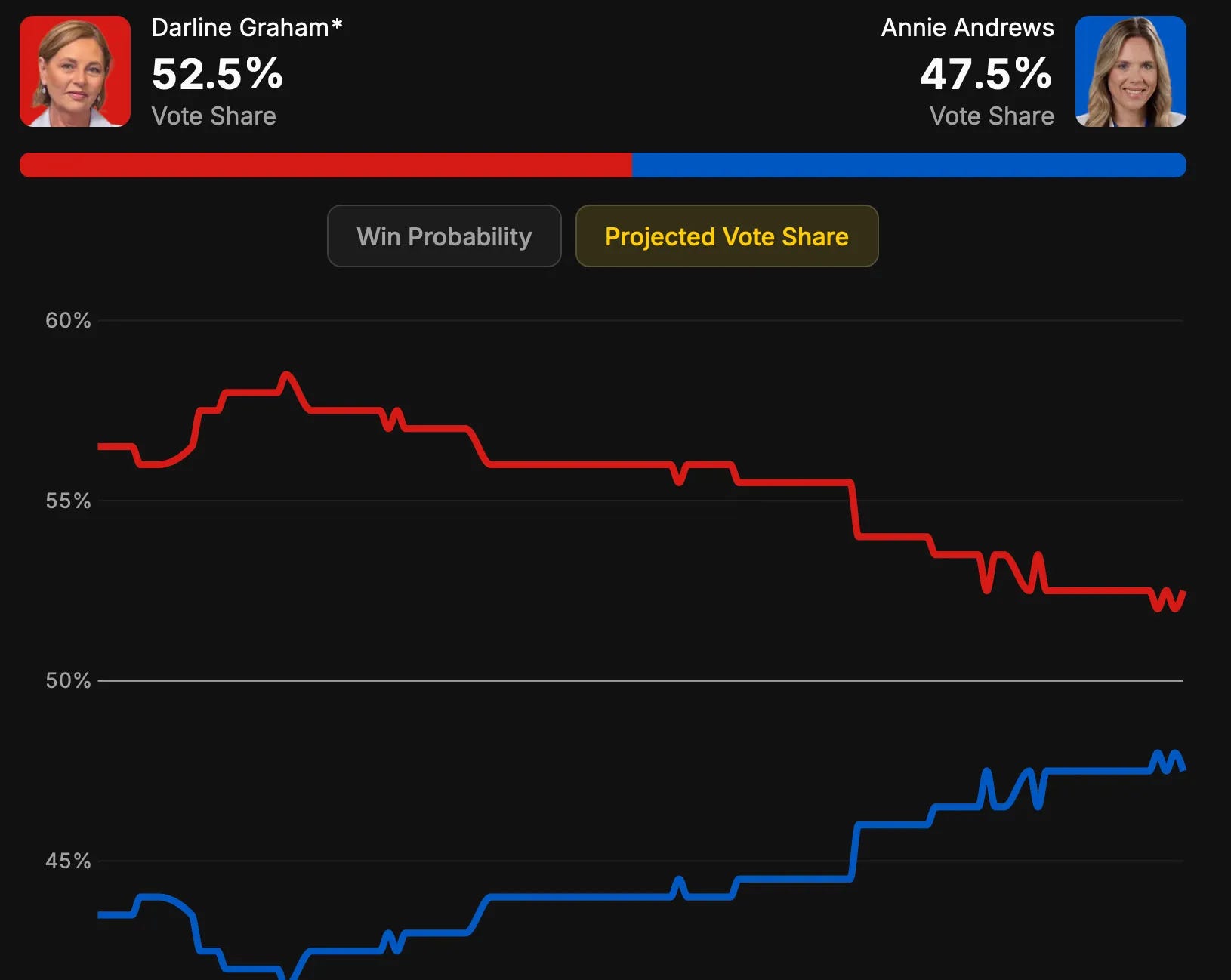
To put it gently, if Republicans are fretting about South Carolina, retreating from North Carolina, and defending Kansas — and if Trump is focusing on getting out the vote in places like Oklahoma and Alabama — then Democrats should be feeling pretty, pretty good about November.
The thing is, as someone who has many friends who are Democrats, I know that most of them are congenitally incapable of feeling good about American politics. This old clip from The Simpsons still resonates:
So, as a fun exercise, the hard-working staff here at Drezner’s World thought it would be useful to game out the worst-case scenarios for Democrats. Consider this a form of exposure therapy: perhaps if Democrats confront their words fears about how November will play out, they will not need to act like they’re in an SNL parody ad:
Based on the chatter I am reading, Democratic doomscrolling fears fall into one of three categories:
The current polling has a strong systemic Democratic bias and therefore does not reflect reality (the Polling Mirage Doomsday); or
Political reality will shift against the Democrats between now and November 3rd to tip the scales back in favor of the GOP (the GOP Bounceback Doomsday); or
Democrats will romp but Trump will use the power of GOP-controlled branches of government to ex post thwart any good result (the Fascism Always Wins Doomsday).
Over the next week I plan on addressing each of these fears in turn. For today, it’s time to deconstruct the Polling Mirage Doomsday Scenario.
The polling mirage fear is grounded in recent history. As Nate Silver observes, the polling averages showed a Democratic bias in 2016, 2020, and 2024; that’s a lot of cycles to screw up. CNN’s Harry Enten notes that in September 2018, the polling was biased in favor of Democrats in key midwestern states — 6 points in Iowa, 6 points in Ohio, and 8 points in Michigan. The current polling averages in those races are sufficiently narrow such that if the same bias holds this time around, all three of those Senate seats would go to the GOP.
A few folks have articulated concerns that non-response bias — or perhaps non-finishing-response bias — may be responsible for skewing samples to the left. This is particularly true as pollsters switch from registered voters to likely voters, which is one reason why Democrats are padding their lead in the generic congressional ballot.
Danny Cowan looked at a recent YouGov poll which showed Dems ahead by 8 points among registered voters but 15 points among likely voters — where the definition of “likely voter” was very stringent. He warned:
The difference between Democrats winning by 8% or 15% is substantial. The former implies a 2018-sized blue wave where Democrats are competitive in the Senate, and the latter implies that Democrats win north of 270 House seats and 55 Senate seats. Democrats are very motivated to say they are voting, while Republicans are not. However, if you simply exclude those less-enthusiastic Republicans from polls, you may end up getting a sample that’s too Democratic.
If one reason for the Democrats expanding their leads in recent polling is due to this kind of likely voter switch, one can understand the reasons for concern.
Another reason this polling fear likely resonates with Democrats is that it evokes bad memories of 2020. Sure, Trump lost, but that election was a big swing-and-miss for pollsters. That was also the last year polling suggested states like Alaska, Kansas, or South Carolina might be competitive — polling that, it turned out, was significantly and systemically skewed towards Dems. So it’s easy for Democrats to envision a déjà vu experience in which their dreams of winning back Ohio, Texas, Iowa, Alaska, or even Kansas disappear on the morning on November 4th.
So, is the fear of a polling mirage real?
