

Two years ago during the 2024 presidential election, the hard-working staff here at Drezner’s World mused hopefully about whether the outbidding on trade protectionism by U.S. political parties had finally come to an end.
The post-neoliberal turn in political economy has caused both parties to start bragging about how they think tariffs are nifty and industrial policy is awesome. There was a recent Chris Murphy profile in the New York Times Magazine about how “a middle-of-the-road Democratic senator…. [came to understand how the version of liberalism we’d adopted — defined by its emphasis on free markets, globalization and consumer choice — had begun to feel to many like a dead end and to come up with a new vision for the Democratic Party.” Last month the New York Times’ Ana Swanson concluded, “both… parties are increasingly embracing tariffs as an essential tool in protecting American manufacturers from Chinese and other global competitors.”
Maybe, just maybe, however, we are starting to see an end to the outbidding on protectionism….
If Trump wins in November, all bets are off with respect to foreign economic policy. The political outcome will encourage a return to outbidding. If, however, Harris wins after making it clear that Trump’s brand of protectionism is a tariff too far, then maybe the U.S. can preserve some sanity in its policymaking.
Unfortunately, we all know how the 2024 election turned out. And the discerning readers of Drezner’s World are no doubt aware that the Trump administration has pursued a whole series of galactically stupid trade policies — none more stupid than the trade war with Canada.1
And lo and behold, these policies have mostly been an economic and political bust.
Economically, the tariffs have accomplished very little beyond a moderate increase in inflation and a moderate increase in the trade deficit. Politically, the latest Chicago Council on Global Affairs survey makes it clear — and I cannot stress this enough — that U.S. tariffs are politically unpopular:
The second Trump administration’s widespread tariffs are also deeply unpopular. In Chicago Council polls this year, large majorities of Americans have said that US tariffs on imports have been bad for the US economy (71%) and the cost of living at home (81%). Even Republican Party supporters think the tariffs have been bad for the cost of living (62%), along with overwhelming majorities of Democrats (94%) and Independents (86%)….
The public also believes the tariffs placed on imports specifically from China have negatively impacted the cost of living in the United States (76%) and the US economy (66%).
Pew surveys show something similar:
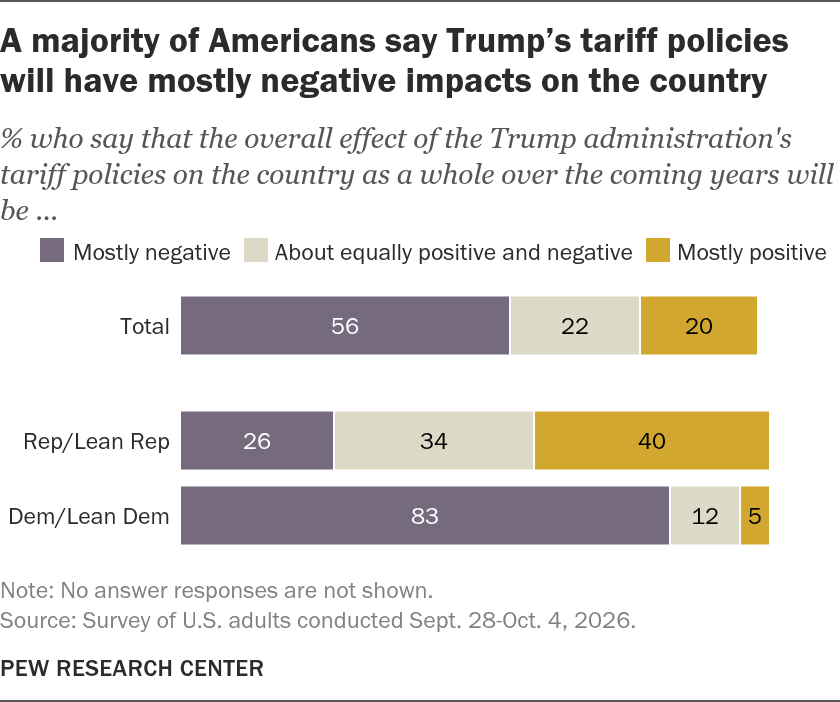
This disenchantment is beginning to have political effects. Democratic politicians during the midterms are starting to sound more pro-globalization. For example, Ohio’s Sherrod Brown has long been an advocate for tough trade policies. But even he is criticizing Trump’s trade policies and writing New York Times op-eds acknowledging that, “a universal tariff or tariffs on countries like Canada aren’t tailored to the biggest risks to American jobs, but they do drive up prices for working people.” Other Democrats are also linking globalization to improving affordability:
All of this has prompted the Quincy Institute for Responsible Statecraft’s Karthik Sankaran to ask in the Financial Times whether U.S. hostility to globalization has peaked:
The White House’s problem is that tariffs and the war have become signature elements of the administration’s foreign policy, and are now seen by a majority of the American public as having increased the threat of shortages and inflation. Meanwhile, even in the 2024 election, the broad state of the economy was the top concern, while “trade with other nations” didn’t even crack the top ten….
There’s little doubt that the globalisation of trade had concentrated effects in certain regions of the US, particularly in the Midwest and Southeast. And the Midwest has functioned as the fulcrum of American national politics for more than a decade. This may have amplified political incentives to focus on trade, particularly because solutions to problems in healthcare, housing, and higher education — the non-tradeable sectors identified by Bessent — appear beyond the realm of cross-party, or even intraparty, political agreement.However, this strategy might have reached its limits for three reasons. The first is that serial disruptions to international trade (whether caused by pandemics, tariffs or war) have led to sufficiently broad-based negative outcomes for two key constituencies. Consumers in general have suffered from higher prices in the wake of negative supply shocks, and American farmers and ranchers in particular have suffered from retaliation (through tariffs or other measures) that cost them access to export markets.
Second, the political map of the US seems to have shifted from where it had settled over the past decade, potentially putting other states “in play,” including those in the agricultural Midwest. These are states that have been winners from global trade, and voters seem to be increasingly perturbed by the impact of tariffs and wars on the economy. Texas, America’s champion exporter, has a Chamber of Commerce whose slogan is “Trade Is Good” and the situation here looks similar.
And last, if globalisation has become less neuralgic, longstanding concerns about the price of healthcare and housing persist, with the latter exacerbated by the jump in mortgage interest rates….
This election season may well coincide with the peak of broad anti-globalisation sentiment as a driver of US domestic politics.
I want Sankaran to be correct. I love the idea that a new version of economic populism focused on making everything more affordable. This is a vastly superior to the extant form of economic populism, which focuses on somehow restoring lost manufacturing jobs that are never coming back.
The thing is, I have been burned in the past hoping this to be true. Sankaran’s argument rests crucially on swing states rejecting anti-globalization arguments. This hinges on how the midterm elections play out in places like Iowa, Kansas, Michigan, and Ohio. We’ll see in November whether this is true.
More significantly, shifts in the public mood will not matter much unless elites in both parties follow suit. Both Democratic and Republican Party policy elites have been banging on for the past decade about how globalization might have lowered consumer prices and increased consumer choice but were also responsible for lost jobs and the hollowing out of the U.S. manufacturing sector and was therefore worth rejecting.
Unless and until leading politicians start relying on different policy elites, I fear that the old economic populist paradigm will remain the accepted wisdom.
It’s telling that even the the U.S. ambassador to Canada is trying to downplay the dispute, saying, “We’re not in a trade war, OK. We’re negotiating some tariffs. From our perspective, we haven’t ruptured.”
Tariffs and related bellicosity are also rewiring trading partners and many nations and companies will trade outside the USA With the result is USA will lose markets to sell into
This is among the reasons the relationship between Canada and the US is not likely to improve in the short or medium term. If we (I'm Canadian) are coerced into a crappy trade deal that infringes on our right to freely trade with other nations, past experience suggests the Dems will just run with it. An increasingly small number of people think the problem is going away with Trump.