The Madman Theory's Perfect Target
Yes, it's moderate Democrats.


The hard-working staff here at Drezner’s World has written at length about Trump’s belief in the madman theory of bargaining and how that faith has not really been rewarded. It’s not that Trump has been unable to coerce other actors in world politics; it’s that those actors were acquiesced due to extreme asymmetric dependence, not because Trump was uniquely able to extract concessions. Indeed, when it comes to brinksmanship with even moderately powerful actors, the T.A.C.O. principle still holds.
I do think, however, that we have discovered the ideal target for Trump’s madman theory of bargaining: moderate Democrats in the U.S. Senate.
By now readers are likely aware that eight Democrats voted with their GOP colleagues on a measure that would re-open the government in return for, well, pretty paltry concessions. The measure preserves the funding for the Government Accountability Office, reverses the civil service reductions in force that Russell Vought attempted to implement during the shutdown, and ensures that a vote to extend health care subsidies will occur in the Senate next month — which will very likely fail to pass the Senate, has no chance in the House, and would be vetoed by Trump.
Given that the goal of Senate Dems was to ensure an extension of health care subsidies, this ain’t much. It is so paltry that even Chuck Schumer opposed the deal.
I recommend reading Josh Marshall’s glass-half-full readout of the deal and Nate Silver’s glass-half-empty take. I particularly want to excerpt Silver’s assessment, as he was initially skeptical of the Dems’ shutdown strategy:
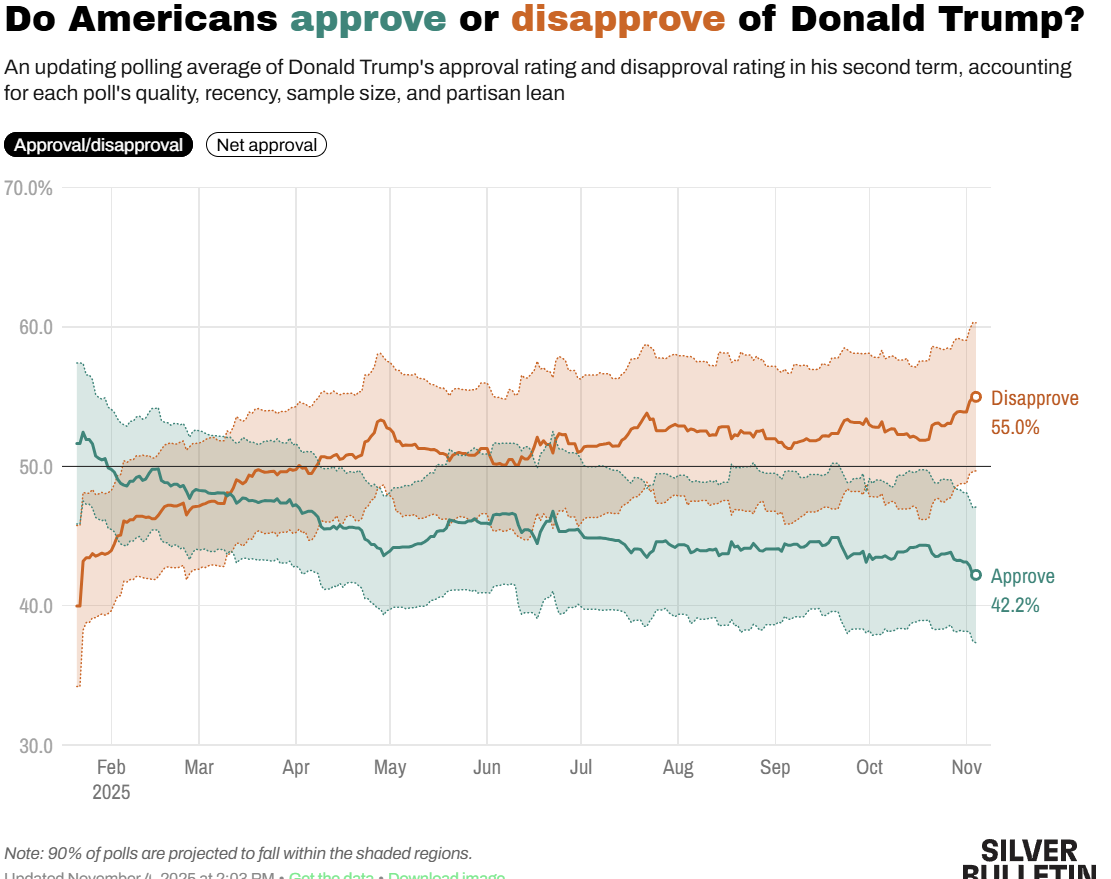
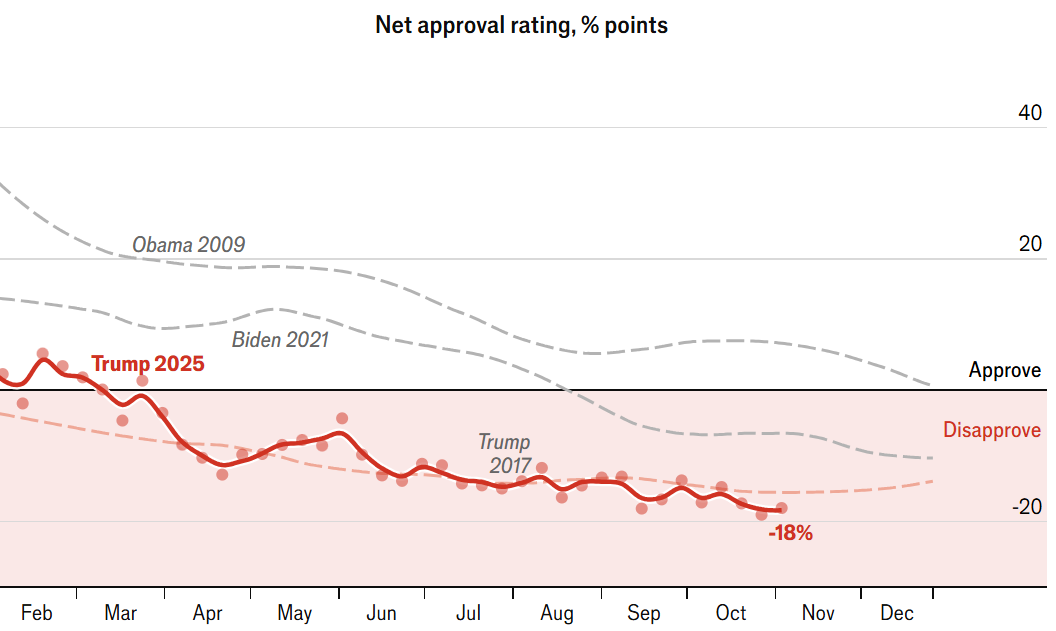
Something changed — and I was getting ready to eat crow. Late last month, Trump’s numbers began to plummet, with his net approval rating falling from −7.5 on Oct. 17 to −13 three weeks later. It wasn’t a huge shift in absolute terms. But Trump has had a high popularity floor and a low ceiling. It was something real enough to contribute to Democrats absolutely crushing Republicans in a series of elections last Tuesday in New Jersey, Virginia and other states. Meanwhile, Trump was starting to feud with Congressional Republicans, urging them to “nuke” the filibuster when leadership was reluctant to do so.
So what did Democrats do with their newfound leverage? Over the weekend, they just gave up….
As political strategy, I think this is malpractice. Predictable enough malpractice for a perpetually risk-averse party with a weak, unpopular leader who clearly doesn’t have confidence of his caucus. But malpractice all the same.
So what happened? Silver’s account of the Dems piss-poor bargaining strategy is worth reading in full, but it omits an important point: it turns out that Trump’s madman strategy works really well on moderate Democrats.
The Democrats’ strategy during the shutdown was, um, not great. Silver is correct to note that a strategic government shutdown tends to work out poorly for those who instigate it. The thing is, Trump’s response to this strategy was even worse.
As the New York Times’ Michael Gold noted:
Presidents usually want to show that they are taking great pains to end a government shutdown, and that they will force congressional leaders to come to the table and bargain their way out of gridlock.
Not so with Mr. Trump.
The president did not once invite Democratic leaders to the White House during the shutdown to negotiate. He did not travel to the Capitol to show that he was leading the way toward a solution.
Instead, he stoked the impasse in social media posts in which he vehemently encouraged Republicans to hold the line, a message he communicated to G.O.P. senators in person at two gatherings at the White House. He cast Democrats as intransigent, and as the consequences of the shutdown mounted, he urged G.O.P. senators to find a way around them, including by ending the legislative filibuster.
If anything, this understates Trump’s intransigence. He did not just refuse to negotiate. During the shutdown month he also completely bulldozed the East Wing, cut SNAP benefits, witnessed producers passing on the cost of tariffs to consumers, announced curbs on air travel, and participated in a Great Gatsby-style party at Mar a Lago.
None of this — none of this — was in any way popular, and that sure showed up in the polling:
So why did moderate Democrats buckle after a week in which the party had a great off-year election and congressional Republicans rebuffed the president on the filibuster? Because there was one advantage to Trump’s kamikaze tactics — they signaled that the president was perfectly willing to take actions that would hurt ordinary citizens even if they were going to torch his own popularity.
From a purely political perspective, Democrats should have been willing to accept that tradeoff. The more Trump takes actions that harm ordinary Americans, makes food and health care less affordable, and reveals how out-of-touch his administration is with the needs of citizens, the less popular he becomes. And the less popular Trump is, the more likely that they win next November, that congressional Republicans find some backbone, and so forth.
But the shutdown was not just about politics — the human suffering was very, very real. Government employees were not getting paid. Families dependent on SNAP were not getting food. The risk to flying was rising just as the holiday season was starting.
None of these things seemed to perturb Trump, but they obviously perturbed those moderate Democrats. Politico’s Katherine Tully-McManus offers a rundown of the Democratic Senators who recently flipped.1 You can see a pattern in their responses:
Catherine Cortez Masto: “she described ‘lines like I haven’t seen since the pandemic’ for food banks in Nevada to reporters during the vote Sunday night and said that that opening the government ‘was key to stopping that pain.’”
Dick Durbin: “This bill is not perfect, but it takes important steps to reduce their shutdown’s hurt.”
Maggie Hassan: “I’ve heard from Granite Staters who can’t afford a doubling of their health insurance costs. I’ve also heard from families about the deep pain that the government shutdown has caused.”
Tim Kaine: “This legislation will protect federal workers from baseless firings, reinstate those who have been wrongfully terminated during the shutdown, and ensure federal workers receive back pay.”
Jeanne Shaheen: “This was the only deal on the table. It was our best chance to reopen the government and immediately begin negotiations to extend the ACA tax credits.”
One can give Trump credit for two things during this past month of deadlock: he succeeded in holding the GOP congressional caucus unified, and he made it clear that he did not care about who suffered as a result of the shutdown.
Most Democrats were perfectly willing to dig in their heels, because based on raw politics it hurt Trump more than it hurt themselves. For moderates, however, the economic and psychic pain of those affected by the shutdown outweighed the political gain of holding out even longer.
What does this mean going forward? Mostly that Trump will be eager for even harsher brinksmanship tactics going forward. It will therefore be interesting to see whether this one weird trick continues to work on moderate Democrats.
Developing…
Catherine Cortez Masto and John Fetterman had consistently voted with the GOP to open up the government again since the start of the shutdown.
The Dems are a bottom up coalition of sometimes competing interests barely held together by the belief that govt can & should make life a little less nasty, brutish, & short. The GOP is a top down ideological party captured by Trump dedicated to destroying the federal govt as we've known it for 90 years. There's no way the Dems were going to save ACA, Medicaid, SNAP, or anything else, shutdown or no shutdown. What they've managed to do is demonstrate just how malevolent Trump & his whores, hacks, & grifters really are. Could they have done as much without a shutdown? Probably. Could they do more by extending it? I don't see how. Time to move on.
BTW, disgust with the Dems for not being more effective is silly. No one knows how to stop Trump, not the courts & certainly not the GOP establishment ante. The best anyone can hope for is that he'll self-destruct. permanently damage the GOP, & give the Dems a chance to fix whatever they can.
It’s possible … just barely possible … that when this deal ends in January after
— the House and Senate vote against extending the subsidies
— the big jump in insurance costs have kicked in
— Trump has done more crazy and unpopular stuff
— there’s no longer the prospect of ruining holiday travel, which would have been bad for Dems as well as Republicans
— and with Dems having positioned themselves as the responsible, moderate,flexible party
that … the Eight will sign on for a new shutdown with their party in a stronger position?
I don’t think this reopening is happening for such strategic reasons. And cave once, cave always is far more likely. But … a guy can hope, can’t he?