Why Trump's Militarism Won't Split MAGA
Local Area Political Scientist Points At Sign Again


It has not gone unnoticed among the commentariat that Donald Trump has been super-eager to brandish the threat and use of force all order the damn planet. In this month along — particularly since the Venezuela operation — Trump administration officials have freely threatened countries ranging from Mexico to Nigeria to Denmark to Iran with military action. That comes on top of 2025 threats or uses of force in all of the places listed above plus Panama, Gaza, and the Red Sea.
That covers most of the continents on this planet.
As the hard-working staff here at Drezner’s World explained late last year, “the old neoconservative arguments are not just re-emerging under a MAGA guise — even the neoconservative wishcasting of how ‘All Problems Can Be Solved By Invading Country X’ has returned in full force.” Despite pre-inauguration claims among the MAGA faithful that Trump would shy away from overseas entanglements, he has shown a more militaristic appetite over the past year than during his past term.
This has come through most clearly in his latest threats against Iran:
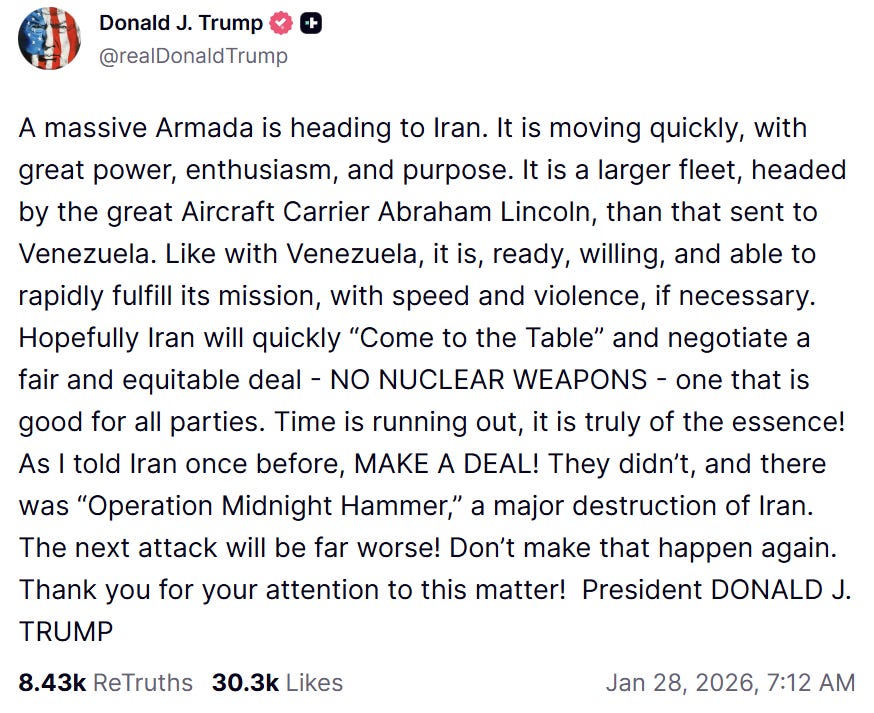
Despite qualms in the region and a rather confusing set of demands from the Trump administration, this administration sure is acting as though American force will be applied towards Iran.
In theory, this should not sit well with Trump’s base, who tended to agree with Trump’s harsh criticism of Iraq and Afghanistan back in the day. Indeed, some MAGA elites like Steve Bannon and Tucker Carlson did criticize Trump’s turn towards militarism last summer. And this has led many political reporters to ponder whether Trump’s militarism might trigger a split within his base.
However, when Politico’s Ian Ward asked conservative pollster and strategist Patrick Ruffini about this possibility, Ruffini dismissed it:
WARD: Is there any evidence that things like Trump’s immigration crackdown or his foreign policy adventurism are contributing at all to the erosion of support among this group?
RUFFNI: I have to laugh at the idea of foreign policy being decisive for a large segment of voters. I think you could probably say that, to the extent that Trump had some non-intervention rhetoric, there might be some backlash among some of the podcast bros, or among the Tucker Carlson universe. But that is practically a non-entity when it comes to the actual electorate and especially this group that is floating between the two political parties. Maybe there’s a dissident faction on the right that is particularly focused on this, but what really matters is this cost-of-living issue, which people don’t view as having been solved by Trump coming into office. The White House would say — and Vance said recently — that it takes a while to turn the Titanic around.
WARD: Which is not the most reassuring metaphor, but sure.
RUFFINI: Exactly, but nonetheless. I think a lot of these things are very interesting bait for media, but they are not necessarily what is really driving the voters who are disconnected from these narratives.
Ruffini is very much a Republican booster. In this case, however, he’s not wrong. To repeat a theme that I have been articulating for well over a decade, most Americans do not fundamentally care about American foreign policy. As I wrote for the New York Times:
Poll after poll shows that when Americans are asked what they consider the most important issue in presidential campaigns, an overwhelming majority choose the economy. Answers related to foreign policy or national security typically yield between 3 and 5 percent. Many pollsters don’t even bother asking about international issues because it seems manifestly obvious that they’re not terribly important.
And that leads us to the latest polling by Politico about how everyone — but particularly Trump voters — feel about Trump’s use of force. And it turns out that an awful lot of MAGA are okay with Trump’s use of force:
President Donald Trump’s MAGA base, known for its aversion to U.S. involvement in foreign wars, has embraced the administration’s aggressive use of military force abroad and would strongly support more.
A new POLITICO poll reveals 65 percent of Trump voters support the U.S. taking military action against at least one of several potential target countries, including Iran, Greenland, Cuba, Colombia, China and Mexico.
And one stands out: Iran. About 50 percent of Trump voters backed military intervention in the country, the most of any foreign target. That number rose to 61 percent of respondents who described themselves as “MAGA Republican” Trump supporters.
The poll data offers a clear view of a political movement that’s adapting its “America First” views to account for Trump’s expansive use of American military might, from orchestrating the capture of Venezuela’s leader to bombing Iran’s nuclear facilities….
While Trump campaigned against “endless wars” and pledged to focus on the homeland, his shift toward interventionism hasn’t rankled his supporters — in fact, he’s drawing solid support from the MAGA base.
Beyond yet again confirming the end of Animal Farm, does this mean that Trump will not pay a political price for his military adventurism? Not exactly. Even if Trump’s use of force does not cause a fracturing of the MAGA base, there are two ways it will matter electorally.
First, if more than a third of MAGA opposes Trump’s use of military force in any high-profile place, that matters electorally. For Republicans to do well in the midterms Trump has to mobilize his base to go out and vote — something they tend not to do when his name is not on the ballot. If a third of his base becomes disaffected over the use of force, that is a contingent that will decide not to vote. That would hurt the GOP’s chances this coming fall.
Second, even if Trump’s base largely sticks with him, criticism of his foreign policy actions can resonate with the rest of the electorate. Democrats can and should push the narrative that Trump is focused way more on bombing other countries than making the American Dream more affordable to more Americans. Even if the administration follows through and the attacks on Iran work out okay — and that is a big presumption — the connection between Iranian regime change and improving American welfare does not really exist.
Most Americans still do not fundamentally care about American foreign policy. But they do care if it distracts the president from focusing on other aspects of their job. And mobilizing that demographic matters far more than Trump’s base.
I am a veteran and later worked for the Department of Defense for more than 30 years. A large part of the military comes directly from Trump’s base. I never ceased to be astounded by the fact that these folks do not draw a line between foreign wars and the chance that their kids and nieces and nephews and grandchildren are more likely to die or be permanently physically or mentally damaged if Trump starts another dangerous and totally unnecessary war.
In his first term, Trump tried to bluff his way to cheap victories with threats (North Korea, 2017; Iran, 2019). This term, he has moved to making quick strikes from a distance, then declaring victory and moving on. That's still different from the invasions and drawn-out quagmires of the G W Bush administration.