Is Blueskyism Really a Thing?
A few thoughts on Nate Silver's thesis that the weird politics of 2020 explains the authoritarian politics of 2025.


A week ago Nate Silver tweeted the following warning to Democrats:
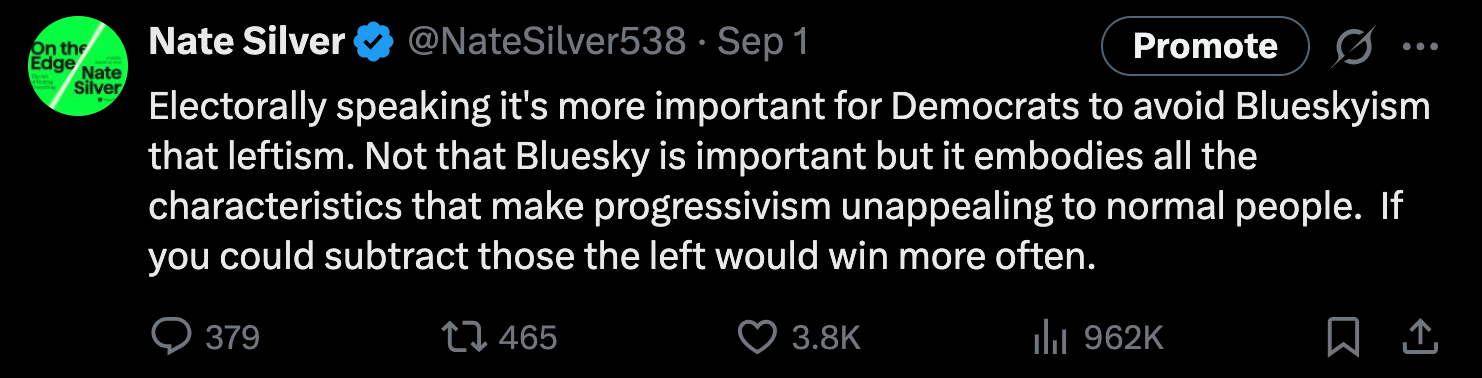
Okay, but what is Blueskyism? Last Friday, Silver elaborated on what he meant in a Substack post. Let’s excerpt!
Blueskyism’s peak actually came before Bluesky was a thing, in roughly 2019/2020. (You’ll notice that Blueskyists often have a lot of nostalgia for this period,1 the one and perhaps only time when they improbably became the prom king.) This timing coincided with the 2020 presidential primary, when there was a huge gap between the most prominent voices on Twitter and those of the actual Democratic base. The ultimate result was the rejection of various more “online” and left-wing candidates for the stodgy and more centrist Joe Biden, but choices made during period continued to cast a shadow on the 2024 campaign, particularly after Harris’s statements during that period were scrutinized once she took over for Biden….
However, this isn’t the standard claim that Democrats should move to the center….
As we’ve seen over the past few months, Blueskyist attitudes aren’t actually winning out in the “marketplace of ideas”, as some Blueskyists would like to think. If they were, it wouldn’t be the case that Bluesky is getting just 1/60th of X’s traffic….
The three essential characteristics of Blueskyism.
The first essential characteristic: Smalltentism
Aggressive policing of dissent, particularly of people “just outside the circle” who might have broader credibility on the center-left. Censoriousness, often taking the form of moral micropanics that designate a rotating cast of opponents as the main characters of the day. Self-reinforcing belief in the righteousness of the clique, and conflation of its values with broader public sentiment among “the base”….
The second essential characteristic: Credentialism
Appeals to authority, particularly academic authority. Centering of the suitability of the speaker based on his or her credentials and/or identity characteristics (standpoint epistemology) as opposed to the strength of his or her arguments, accompanied by the implicit presumption to claim to be speaking on behalf of the entire identity group….
The third essential characteristic: Catastrophism
Humorless, scoldy neuroticism, often rationalized by the view that one must be on “war footing” because the world is self-evidently in crisis. Sublimation of personal anxiety as a substitute for political activism or material solutions to the crisis, with expressions of weariness and pessimism signaling virtue and/or savviness….
Most people outside of Bluesky don’t think like this. Although literally almost zero Democrats are happy with the state of the country, overwhelming majorities of Americans are happy with how their personal lives are going and are able to compartmentalize politics away or recognize that other things matter in life, too.
The hard-working staff here at Drezner’s World would like to take issue with Silver’s neologism — but first, it is worth acknowledging when his explanation resonates. When I posted Silver’s essay on Bluesky, the responses on the site were… well, pretty much exactly how Silver describes Blueskyism. I enjoy Bluesky a great deal more than Silver but I also cannot deny that the strain of rhetoric he describes above certainly exists there.2
If Silver had restricted his post to “I find Bluesky annoying and humorless and the big accounts there are likely to punch harder at center-leftists than conservatives,” he may have been on solid ground. But his post has greater ambitions — and is therefore worth dissecting.
First, Silver’s claim that “Blueskyist attitudes aren’t actually winning out in the ‘marketplace of ideas’” because Bluesky itself is not surpassing Twitter does not make a whole lot of sense. For one thing, as he explicitly acknowledges, Blueskyism and Bluesky are not coterminous. Whether the site is thriving or not says little about whether the ideas Silver identifies are thriving or not.
Second — and I cannot stress this enough — Blueskyism, as Silver defines it, is not wedded to any particular political ideology. Silver’s three tenets — smalltentism, credentialism, and catastrophism — are all about political style and not political substance.
Style is important. It perfectly characterizes a particular strain of leftist political discourse that Silver and other centrists despise. But Silver’s definition of Blueskyism is also a note-perfect description of the MAGA movement. And if the political style he disdains exists across the political spectrum, then I’m not sure Blueskyism is a real thing.
Consider smalltentism. While there were certainly nascent signs in 2024 that MAGA might have some multicultural appeal, I think it’s safe to say that the administration’s policies in 2025 have caused that to evaporate. Indeed, the polling now suggests that Trump’s Hispanic support has cratered. Trump’s cabinet appointees have to make sure that they stay on the right side of Laura Loomer. Trump has fully backed RFK Jr/’s jihad on vaccines, a deeply unpopular position even within the MAGA base. Sounds like a pretty exclusionary movement to me!3
Now consider credentialism, which might be the source of Silver’s greatest animus towards Blueskyism. To be sure, MAGA does not appeal to academic authority all that much.4 They definitely appeal to authority, however — an authority that comes from net worth rather than diplomas. Trump’s second term appointments can be distilled down to the idea that an individual’s wealth is a revealed indicator of their intelligence and capacity to run the government.
Silver argues that “the experts have made a lot of mistakes, and sometimes the reason is because they’ve become self-serving in pursuit of social media validation or blinded by political partisanship. Increasingly often, I’ll see academics engage in incredibly sloppy argumentation and this seems to be correlated with recent exposure to Bluesky.” And sure, academics have committed those sins on social media. I would note, however, that I have seen Trump’s plutocrats make even more significant mistakes, and this is definitely correlated to their own embrace of MAGA and the political cocoons that they have created. This, in turn, might explain the rapid erosion of American trust in big business.
Finally, there is catastrophism — and dear God the MAGA movement has trafficked in this trope from “The Flight 93 Election” to the present day. Trump’s entire political career is premised on the contention that America is teetering on the brink of catastrophe. He campaigned in 2024 on the premise that if he wasn’t elected, there would not be a country anymore. He has governed in a similar manner, depicting cities as “hellholes” that warrant military interventions. His administration’s argument to maintain tariffs is also based on catastrophism. As Jamelle Bouie noted last month, “for reasons of both personality and political ambition, Trump needs a crisis to govern — or rather, to rule. And if the actual conditions of reality will not give him a state of exception, he’ll create one himself.”
My point here is not to make a tu quoque argument justifying Blueskyism on the left by highlighting Blueskyism on the right. I agree with Silver that these are, by and large, not attractive qualities to see in a political movement. Rather, my point is that for Silver’s descriptive inference to be of any utility, it has to a) apply specifically to the political demographic of interest; and b) provide some analytical leverage. The fact that Silver’s definition of Blueskyism applies with equal force to MAGA — a movement that has notched multiple political wins over the past year — dilutes the utility of his definition.
There is also a more significant question to raise about Silver’s distaste with catastrophism. No doubt, the constant crying of wolf when there is no real danger can become a political liability. What happens, however, if the concerns about catastrophe are warranted?
Silver identifies Ezra Klein as one of Blueskyism’s “biggest enemies.” But Klein’s latest New York Times column, “Stop Acting Like This Is Normal,” sounds… what’s the right word to use here… catastrophic:
We are no longer in the muzzle velocity stage of this presidency. We are in the authoritarian consolidation stage of this presidency.
I want to be very clear about what I am saying here. Donald Trump is corrupting the government — he is using it to hound his enemies, to line his pockets and to entrench his own power. He is corrupting it the way the Mafia would corrupt the industries it controlled. You could still, under Mafia rule, get the trash picked up or buy construction materials. But the point of those industries had become the preservation and expansion of the Mafia’s power and wealth. This is what Trump is doing to the government. This is what Democrats cannot fund. This is what they have to try to stop.
Just in the past few months, we’ve watched Trump fire the head of the Bureau of Labor Statistics because he didn’t like the jobs data. We watched him fire the head of the Defense Intelligence Agency after it suggested that the administration’s strike on Iran set its nuclear weapons program back by only months.
We watched him muse about firing Jerome Powell, the chair of the Federal Reserve, and now we’re watching him try to fire Lisa Cook, a Federal Reserve governor, for alleged mortgage fraud. We’ve watched Trump sic his government on Senator Adam Schiff of California and Attorney General Tish James of New York — again, allegations of mortgage fraud. I will note that this is not coming after an exhaustive review of the mortgage documents of every person serving across the executive branch under Trump. This is what authoritarian governments do: Look hard enough, and all people have done something wrong, and even if they haven’t, you can cause them a lot of trouble by just saying they have….
We’ve watched Trump deploy the National Guard to Los Angeles and then to Washington, with more cities expected to come under federal military occupation soon. We’ve watched masked ICE agents conducting raids all over the country, refusing to reveal badge numbers or warrants. We’ve watched Trump systematically purge the government of inspectors general, of military JAGs and officers, of federal prosecutors — anyone who might stand in the way of his corruption or his accumulation or exercise of power. It is astonishing that the Jan. 6 rioters have been pardoned and that dozens of the Justice Department lawyers who prosecuted them have been fired.
This is not just how authoritarianism happens. This is authoritarianism happening.
I am a bit more optimistic than Klein — but only a bit.
With stakes like these, opposition movements should aim for a big tent and embrace expertise and ingenuity from all those willing to contribute. Silver is right to caution against an unflattering political style. Where I vehemently disagree with Silver is the notion of downplaying the risk of catastrophe. The catastrophe is very real.5
Silver’s argument is rooted in the premise that Democrats’ political overreaches during the 2019/20 political cycle led to Trump’s 2024 victory. He is not alone in making this argument: see, for example, Sean Trende, Megan McArdle, or Jeff Blehar as well. I would agree about the 2020 overreaches but am far less convinced about how consequential they were. in 2024. As Nate has acknowledged, Trump won in 2024 primarily because Americans really, really do not like inflation.
In conclusion, I share Silver’s distaste for the political style he labels Blueskyism. But what he is describing is hardly confined to progressives, or to those on Bluesky — and therefore not the political problem that Silver believes it to be.
For the record, I don’t know a single person who has nostalgia for that period.
My secret to avoiding these kinds of posters on Bluesky is twofold: a) don’t follow them; and b) post something mildly controversial on a quarterly basis and block anyone who acts the way Silver describes in response.
This is also perfectly consistent with populism as a political movement. As Jan-Werner Müller pointed out in his primer What Is Populism?, populists campaign and govern on the basis of their claim to exclusive moral representation of the people — with the definition of “the people” restricted to in-group members only.
This is a bit more complicated than it first appears, however. Trump is fond of mentioning his Ivy League credentials and how his uncle worked at MIT. He also trumpets the Ivy League bona fides of his compatriots when they exist. See: Vance, JD, and Hegseth, Pete. On the other hand, most of Trump’s key supporters and staffers are not exactly oozing with meritocratic vibes.
In his post Silver highlights polls showing that Americans are largely happy with their personal lives as evidence that catastrophism is exaggerated. But that mirrors what the polling showed in 2023 and 2024. And yet when Blueskyists tried to defend the Biden economy from MAGA catastrophists, they were accused of being out of touch with real Americans.
Nate Silver is a class A A-hole. What led to 2025 authoritarianism is FOX News lying enablers, years of Republican gerrymandering, voter suppression and corporate greed in both/all parties. Also did not help that we lost sight of how social media can be manipulated. Nate Silver keeps reaching foe relevance and missing the ledge.
"My secret to avoiding these kinds of posters on Bluesky is twofold: a) don’t follow them; and b) post something mildly controversial on a quarterly basis and block anyone who acts the way Silver describes in response."
I find that they block me, which usually makes it easier. Getting on the various block lists can be useful that way, too. I managed to get on a Genocide Deniers block list and a Hamas Supporters block list at the same time.